As the holiday season approaches, many people have a mental image of calming turquoise oceans and nothing to do but chill. But as we plan our vacations, what is it we really need?
One’s mind conjures an image of the Maldives with remarkable ease: bungalows perched over turquoise shallows, a sense of perfect, uninterrupted calm. This vision is not untrue. But it is incomplete. It captures but a single facet of one of the most extraordinary and delicate living systems on our planet.
This is an archipelago born of coral. A scattering of nearly 1,190 islands, the remnants of ancient submerged volcanoes, strewn across 26 natural atolls. It is a nation whose highest point is barely two metres above the sea, spanning 90,000 square kilometres of the Indian Ocean. Only 200 of these islands are inhabited. To see it only as a place of pristine, decorative beaches is like visiting Venice for its canals and ignoring the wonder of the city itself.
A City Like a Coral Head
The capital, Malé, is often dismissed as a mere transit point. But look again. It is, in its own way, a marvel of adaptation.
Here, on less than six square kilometres, is the bustling, thriving heart of the nation. It is a human reef, a tightly packed colony where the entire apparatus of a modern state coexists with traditions that stretch back centuries.
Before the sun rises, the fish market stirs. This is a theatrical display of the pulse of maritime people. The boats arrive, unloading their catch of tuna. Traders negotiate in Dhivehi—the unique, ancient language spoken by the Maldivian people—as the great fish are filleted with astonishing speed and moved to stalls by mid-morning. This single fish has anchored Maldivian livelihoods and cuisine for millennia, a system of commerce that predates the resort industry by generations.
A few streets away, the Hukuru Miskiy, the Old Friday Mosque, stands as a testament to this remarkable ingenuity. It was built in the 1650s not from imported timber, but from the reef itself—intricate blocks of coral stone, carved with breathtaking precision and ancient Quranic script. It remains an active place of prayer to this day.
Malé is the spectacular contrast. It is a reminder that this is not just a holiday destination; it is a nation, a culture, a working, breathing society functioning in a dense coastal city balanced precariously at sea level.
The Hidden Spectacle
It is beneath the surface, of course, that the true marvels unfold.
There are places here, like Hanifaru Bay, that hold one of the planet’s great natural wonders. It is a place so vital that UNESCO has designated it a Biosphere Reserve. Between May and November, the changing monsoons create a trap for plankton, and with this microscopic bounty comes a gathering of global significance.
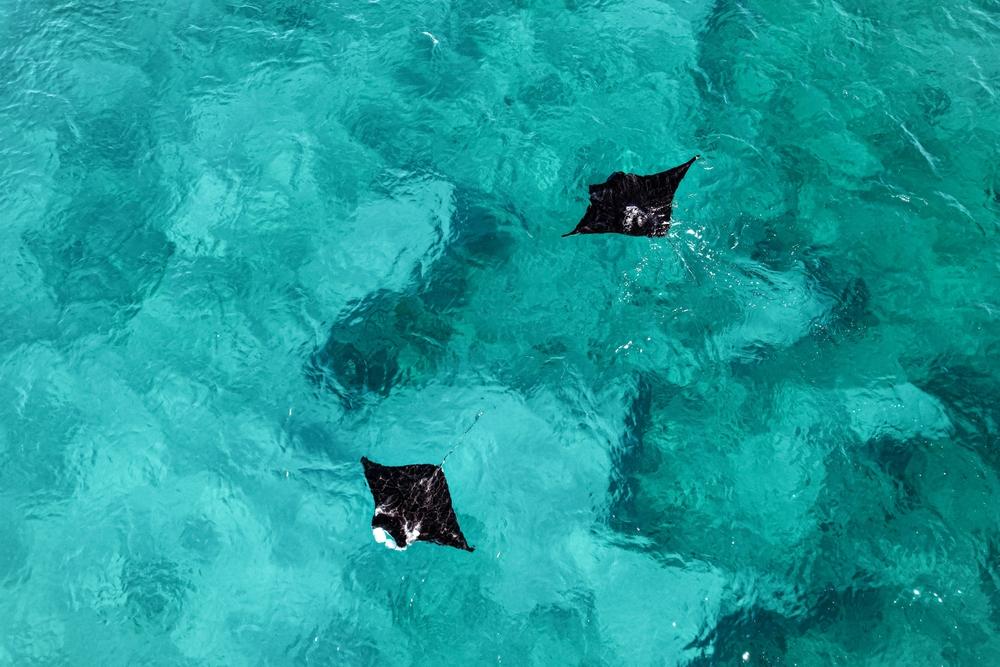
Manta rays, colossal and graceful, congregate not in their dozens, but by the hundred. They are not merely swimming; they are engaged in a ballet of breathtaking complexity, performing spiralling ‘cyclone’ formations that are both beautiful and mysterious.
And they are not alone. In the deeper channels, the largest fish in the world, the whale shark, glides through the water. One encounters reef sharks at Manta Point and sea turtles along the drop-offs. This is a world not of static beauty, but of constant, vital drama.
The Keepers of Craft
Venture beyond Malé to the outer atolls, to islands like Thulhaadhoo and Fuvahmulah, and you find a world driven by a different pulse. Here, the human story is etched in creation.
You can find workshops where lacquer work is still produced with astonishingly patient skill. And perhaps most importantly, you can see the dhoni boats—the traditional wooden vessels that have served this nation for generations—still being built by hand. This is not a relic; it is a living tradition, a technology perfectly adapted to this environment.
It is an invitation to witness, to learn, and perhaps even to create—to fashion a memento, not a mere souvenir, but something of personal value to carry home to those you love.
An Archipelago of Worlds
The Maldives, you see, is not one single experience. It is a multitude. It is a place that accommodates remarkable extremes.
One can find profound stillness. But one can also find marine biologists giving lectures about their specialised research and the behaviour of marine organisms, or even critical issues like climate change and pollution’s impact on ocean ecosystems.
One can watch the sunset, or one can join a coral restoration project.
It is a place where a family can find individual adventures. Grandparents may rest in a spa villa, while grandchildren freedive the house reef, and parents cycle between the two. They reconvene at dusk, each with a different tale to tell.
The Question of Perception
The assumption that the Maldives offers only one experience—passive luxury, a time for simple recalibration—misses the point. Yes, the beaches offer serenity.
But the archipelago holds so much more, if one only knows where to look. It holds the fish market operating on centuries-old knowledge, the dhoni boats built using methods that predate modern tourism, and the quiet navigation techniques still taught on the outer islands.
The question, then, is not whether this place offers relaxation. It does, profoundly. The question is whether we are willing to look beyond the resort perimeter, to understand the intricate, fragile story of how this nation of coral atolls truly functions.
The Invitation:
The true privilege, one finds, is not merely to visit, but to be dazzled—to see beyond the relaxation and take the guidance from the lessons with the marine biologists to be more ecological. A responsible consumption of this beautiful planet.
Speak with our team to discover the complete experience of this magnificent archipelago.